The Garden in the Hills, the subtitle to Arthur Mee’s guide to The Kings England, Worcestershire, suggests that the county was once renowned for market gardening. The modest road sign for ‘NEWEY’s Hill’ stands at the corner of what is now a private path off Eastbank Drive, which runs along the Northwick Road, about half a mile out of Worcester city centre.
My research into my married name NEWEY was to discover many things, including a family link to ‘NEWEY’s Hill’ and to several generations of NEWEYs who were market gardeners.
Ernest NEWEY ‘Nurse Child’
According to the 1871 census return, my family ancestor ‘Earnest’ NEWEY, was aged two years, born about 1868 in Claines and a ‘nurse child’, found living with brother and sister Henry and Louisa TEAGUE, and their married sister Annie Hill HODGES and her family, in Powick, an area a short distance to the south west of Worcester City centre and Claines.
I obtained a copy of Ernest’s GRO birth certificate, which confirmed his birth to be 11th May 1868, at Moorfields, Whistones, to Mary Ann NEWEY with no father listed. An 1861 Street Plan of Worcester illustrates ‘The Moor Fields’ located above Worcester Race Course to the west and lying parallel with the main road through Worcester along the Barbourne Road from the north, along The Tything and on to the High Street towards Worcester Cathedral in the south.
Ernest’s baptism record at the District Churchelry of St George, Claines, Worcester on 28th June 1868, confirmed his mother was Mary Ann NEWEY of Northwick Lane, who was described as a ‘single woman’.
Mary Ann NEWEY ‘Single Woman’
Ten years earlier in the 1861 Census return, I found Mary Ann (a laundress) aged 17 years and born in Claines, Worcestershire, living with her parents John (a Market Gardener) and Mary NEWEY in Barbourne, Claines with three siblings. I obtained a copy of Mary Ann’s birth certificate, which confirmed she was born on 15th July 1843 in Claines, her mother being Mary NEWEY, formerly BAILEY, and her father John NEWEY, a Gardener.
This identified Mary Ann to be the daughter of John NEWEY, one of several generations of Worcester market gardeners. It seemed that NEWEYs, as far as I could tell, had indeed originated from Worcester and worked as market gardeners, but the exact detail of who, where and when had been lost to living memory.
Visiting the Worcester Archive, housed at The Hive, I set out to research the NEWEY market gardeners and what it was like to be a market gardener in 19th century Worcester, and to see if I could I find a link to ‘NEWEY’s Hill’.
Using sources such as directories, court records, apprenticeship and census substitutes, I was able to discover not only detail of market gardeners, but also another family link to a well-known Worcester trade, that of leather glove makers and to realise a family name, since lost in the mists of time.
John NEWEY ‘Market Gardener’
On a summers day in 2013, I paid a visit to the picturesque St John the Baptist parish church of Claines, where I found the grave of John NEWEY (1814-1886) and his wife Mary (nee BAILEY) (1820-1878), pictured below. On it the inscription read:
In Loving Memory
MARY
wife of JOHN NEWEY
of Severn Side in this parish
who died Dec. 21 1878 aged 58
also of the above JOHN NEWEY
who died Dec. 19 1886 aged 72

Mary and John NEWEY burial St John the Baptist, Claines, Worcester
I had located this modest memorial, with its ornate floral engraving and ivy border, using the BMSGH index for Worcestershire MI. The memorial was, I believe, a fitting tribute to the wife of a Market Gardener, and the final resting place of John NEWEY.
The definition of a market gardener is ‘husbandry by means of the hoe’ whereas ‘that by the plough was called farming’, regardless of scale. Market gardening traditionally involved produce of a greater variety, being sold as opposed to feeding the family, and tended to serve the local community, which was extended beyond the local community by the introduction of the railways in the 19th century.

A Bird’s eye view of St John’s Nursery, Worcester
During Victorian time’s, great swathes of Worcester were dedicated to fruit growing and by Edwardian times this was concentrated to the West of Worcester, mainly the St John’s area of the well-known nursery as illustrated above. These market gardens, nurseries and farms in the Worcester area increasingly met the demand of growing populations in the industrial West Midlands, including cities such as Birmingham.
As a result, Claines and Northwick to the north of Worcester remained rural enclaves with unpaved roads surrounded by acres of agricultural land, well into the 20th century. In this part of Worcester, NEWEY’s Hill was one of many lanes which ran down to the River Severn, which at one time had been fordable, or shallow enough to walk across.
I decided to step up my research by examining as many Worcester directories and gazetteers, held at Worcester Archive, The Hive. These identified several NEWEYs as either market gardeners and/or farmers operating in Worcester for a period of over 50 years. The entries for all the NEWEYs in the directories were very modest, with no illustrations or adverts included. The earliest record of a NEWEY was for 1842 and the very latest being 1896, after which there was no further mention of NEWEYs as market gardeners or farmers in Worcester.

1879 Littlebury’s Directory
I found the NEWEY families were listed in various locations over the years, including Claines, Northwick, Northwick Lane, Northwick Road, New Northwick, Barbourne and Severn Side. The property known as ‘Severn Side’, was mentioned for the first time at the death of John NEWEYs wife Mary in 1878, in the 1879 directory for John NEWEY and in the directory for John William NEWEY in 1896. No trace of the property exists today, but using a variety of the Census return enumeration routes, I was able to identify its location, close to where ‘NEWEY’s Hill’ is now located, and not far from where the Kepax Ferry once crossed the River Severn.

NEWEY’s Hill, Worcester
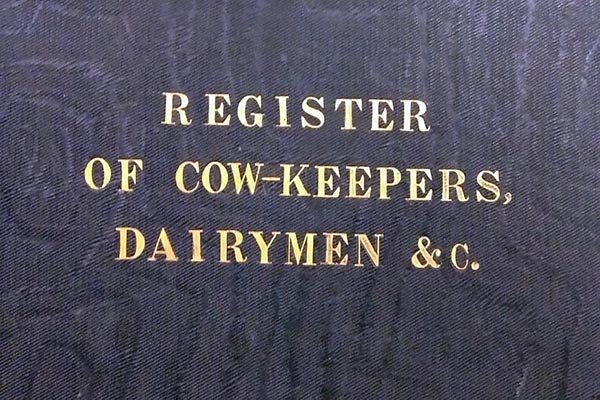
Cow-Keepers and Dairymen
A variety of records came to light during my research, including a Dairyman Register; Worcester City Weights and Measures Department which included cash books, wheat books, corn books; Market committee minutes and various court records. The Dairyman Register 1879 to 1886 included cow keepers in two volumes, one of which was an index which helped to identify persons by name.
Register of The Dairies, Cow-Sheds and Milk-Shops
John NEWEY is included as entry number 683 registered on the 29th April 1879 of Severn Side, Claines, Worcester, ‘Cow keeper & Purveyor of milk’, carrying on the trade from a Cow-shed ‘on the premises’ whereby milk was sold ‘wholesale’:
The following records were included in the Markets series of the Worcester City Archives, and I selected those which were likely to reflect the operation of Worcester market gardeners. The Weights and Measures Inspector’s Report Books 1853 to 1886 contained the tests the inspector carried out to determine if the weights and measures used by traders, market holders and the gas and water works were accurate, and contained some letters and newspaper articles. However there were no references to the NEWEYs of Worcester.
The Weights and Measures Cash books 1834-1866 included schedules of fees for examining and stamping (as proof of accuracy) weights and measures. These cash books were useful as they listed name, residence, trade, the weights and measures inspected and the sums received for examining, comparing and stamping them. The NEWEYs appeared throughout this deposit, including date, name, occupation, what and how much was tested, and the charge for the test:
| Item | Date | Name | Occupation | Amount measured | Charge |
|---|---|---|---|---|---|
| 230 | 27 Dec 1834 | NEWEY | Green Grocer | 3 peck Wooden | 6d |
| 505 | 14 Aug 1836 | James NEWEY | Mkt Gardener | 1 pint Liquid | 1d |
| 12 Jan 1841 | James NEWEY | 1 pint Liquid | 4 ½ d | ||
| 12 Jun 1845 | Mr NEWEY | Market | 1 pint Liquid | 4 ½ d |
Although this research was useful in that I gleaned snippets of various interactions of the Worcester market gardeners and farmers, it had not provided me with any further information illuminating the lives of my NEWEY family. Early on in my research, I had used The British Newspaper Archive to locate newspapers relating to NEWEY’s of Worcester, and it was from a separate piece of research, that I eventually found more than I could have expected.
Alleged Trespass

18th December 1880, Worcester Chronicle
I found a small newspaper article, illustrated above in the Worcester Chronicle 18th December 1880 in regard of an ‘Alleged Trespass’ which I believed might have revealed more than appears at face value. This case of trespass was between Thomas NEWEY v John NEWEY, and included a request for James NEWEY to be co-defendant, which was declined by the Worcester City Court.
I believed Thomas and John NEWEY described above in the newspaper to be brothers, who with their sister Ann, the wife of John CHA(I)R, had received an equal share of their father James NEWEY’s (1785-1861) will. James’s namesake and grandson James (1842-1891), the son of John, had been left his grandfather’s watch.
James here mentioned in the newspaper, would have been the recipient of the said watch, and whom I noted, had been born just five months prior to his grandfather writing the will in November 1842. It seems that James’s (1785-1861) oldest son, Thomas married later in life when he was aged 54, and he and his wife, Susannah had no children between them. Therefore John (b1814) was the only son to provide his father James with a grandson, and hence the bequest of the watch.
Whilst no family relationships were described in this newspaper account, I wondered if an element of sibling rivalry was behind this dispute, so looked to the local court records to see if any more could be revealed. There was a bewildering array of court records held at Worcester Archive, housed at The Hive however, the severity of the crime or incident would determine which court was involved.
Of the three types of courts, the most serious cases would have been heard at the assizes housed at TNA. Lesser crimes such as assault or theft being dealt with in the local Quarter sessions. For the least serious of crimes, the monthly Petty Sessions, held with a Justice of the Peace would most likely have dealt with a case such as this.
Most Petty Session records do not survive at Worcester Archive, as they were most often retained by the Justice of the Peace. The Archive did however, hold some from the 1870s onwards, and it was these that I arranged to view. I examined the Worcestershire and Hereford & Worcester (WHW) Magistrates Court Records, which contained the Petty Sessions for 1880 to 1885 and Special Petty Sessions 1868 to 1882 but to no avail. The case I had seen reported in the newspapers may have been dealt with in the Quarter sessions; so I also viewed the Worcester City Archives, Worcester Court Quarter Session Rolls and Bundles for 1880 to 1881. But sadly nothing further was discovered about the NEWEY dispute.
Who’s the Daddy?
Whilst the court records had revealed little about the NEWEYs, what I discovered was to provide family ties to yet another significant Worcester trade, that of leather glove manufacturing.
In my earliest research into finding out the identity of Ernest Edgar NEWEY’s father, I had been unsuccessful due to the limited range of Bastardy Bonds available according to the archive catalogue. However what I found amongst the Worcestershire and Hereford & Worcester (WHW) Magistrates Court Records Petty Sessions, were Bastardy Order Books, and within them was described the father of Ernest NEWEY.
A Bastardy Order was made at a Petty Session held by the Justices of the Peace for the County of Worcester, on 9th June 1868. Mary Ann NEWEY a Single Woman of Claines made an Application for a Summons on 2nd June 1868 to be served upon one John GRIFFIN of Claines a Glover. Mary Ann alleged John GRIFFIN to be the father of the Bastard Child, which had been born within twelve months prior to the summons.
Mary Ann NEWEY had applied to the Justices in Petty Sessions for an Order upon John GRIFFIN where it was proved that the Child was born a Bastard on the 11th May 1868 of Mary Ann NEWEY. John GRIFFIN was judged to be the father and ordered to pay Mary Ann NEWEY, the sum of five shillings per week for the first six weeks from the birth of the child, followed by two shillings per week until the child was aged thirteen years, to die or if Mary Ann NEWEY should marry.
John GRIFFIN was also ordered to pay Mary Ann NEWEY the sum of fifteen shillings and six pence for the costs incurred in obtaining the Order and ten shillings for the midwife. At last I had found the name of the father of Ernest NEWEY, and with it the possibility of tracking down a long lost branch of the NEWEY family tree.